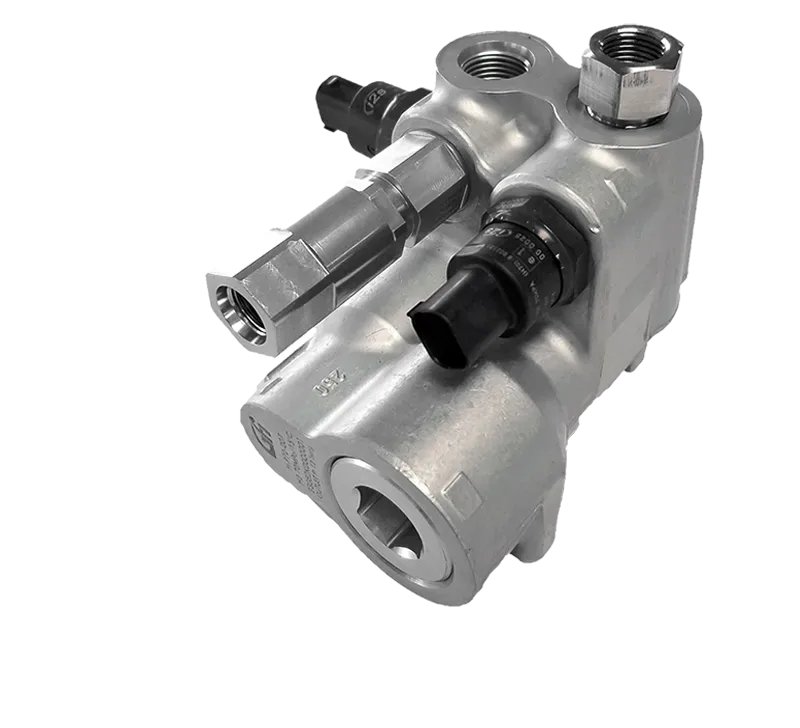
Designed for hydrogen applications up to 70 MPa (10,000 psi), the H-P70 Series Regulator delivers stable outlet pressures under varying flow demands and inlet pressures.
This two-stage piston regulator is a reliable and cost-effective solution to feed any engine or fuel cell. It can also be offered as a first-stage piston with a second-stage diaphragm for even greater outlet pressure performance and stability.
Design
- 2-stage piston design for a cost-effective solution
- Optional first-stage piston and second-stage diaphragm configuration
- Nominal working pressure of 70 MPa (10,000 psi)
Performance & Options
- Optional integrated high and low pressure sensors
- High flow design capable of greater than 4 g/sec H2
- Integrated high flow Pressure Relief Valve (PRV)
- Wide range of factory-set output pressures available
H-P70 Series |
|
|---|---|
General Information |
|
| Application | Hydrogen regulation / pressure reduction |
| Design | Two-stage piston; first-stage piston with second-stage diaphragm also possible |
| Body Material | Aluminum, anodized |
| Fuel Type | Hydrogen per SAE J2719 and ISO 14687 |
Performance |
|
| Nominal Working Pressure | 70 MPa(g) |
| Max Working Pressure | 87.5 MPa(g) |
| Operating Temperature | -40 °C to +85 °C |
| Outlet Pressure | Factory-set; commonly 0.8 MPa(g) to 5 MPa(g) |
| Filter | 10 µm and 40 µm options available |
| Flow Rate | Outlet pressure dependent; capable of > 4 g/s H2 |
Connections |
|
| Inlet Port | Customizable for application (Swagelok FK Series, Voss, and Usui commonly used) |
| Outlet Port | Customizable for application (3/4" commonly used) |
| Optional High and Low Pressure Sensor Port | Customer defined (based on sensor choice) |
| PRV Outlet Port | Customizable for application (3/4" to 1-1/16" commonly used) |
Integrated Features |
|
| Excess Flow Valve (EFV) Activation Setpoint | Customizable for application |
| Pressure Relief Valve (PRV) Activation Setpoint | Factory-set; depends on outlet pressure |
| Optional High and Low Pressure Sensors | Customer defined |
Approvals |
|
| Certifications | HGV 3.1 and EC 79 pending |